Mineworker’s Contests
In 1952, the
Coal Industry Social Welfare Organisation (CISWO) was established to provide essential financial support to miners and to oversee various aspects of their social recreation. In 1962, as part of this remit the CISWO launched its first brass band championships and supported bands in purchasing instruments, and in forming their own junior and training bands. Consequently, the CISWO Championships alongside regional events held in Blackpool soon became regarded as the unofficial 'major' championship, ranking alongside the Open and National brass band competitions. These
Mineworkers contests, held in the Winter Gardens, attracted the best bands from each Coal Board area, fostering a strong sense of communal pride—especially during the fiercely contested solo championships where winners from each discipline advanced to the finals to compete for a cash award and the
Joe Gormley Challenge Trophy.
With the popularity of this contest and the 1974 positively named 'Plan for Coal', brass bands believed they would remain an integral part of community life for decades. However, everything changed with the
1984 Miners' Strike yet, even as pits closed or were amalgamated, participation in brass bands remained strong. In 1994, almost a decade after the strike, the
Mineworkers Contest drew 60 bands—from Grimethorpe and Carlton Main in the top section to Backworth Colliery and Seaham Philharmonic Brass Band in the Fourth section. Nonetheless, the decline in prosperity became evident as 6p from every programme sale was donated to the
Coal Industry Benevolent Trust, which was established to alleviate hardship in mining areas.
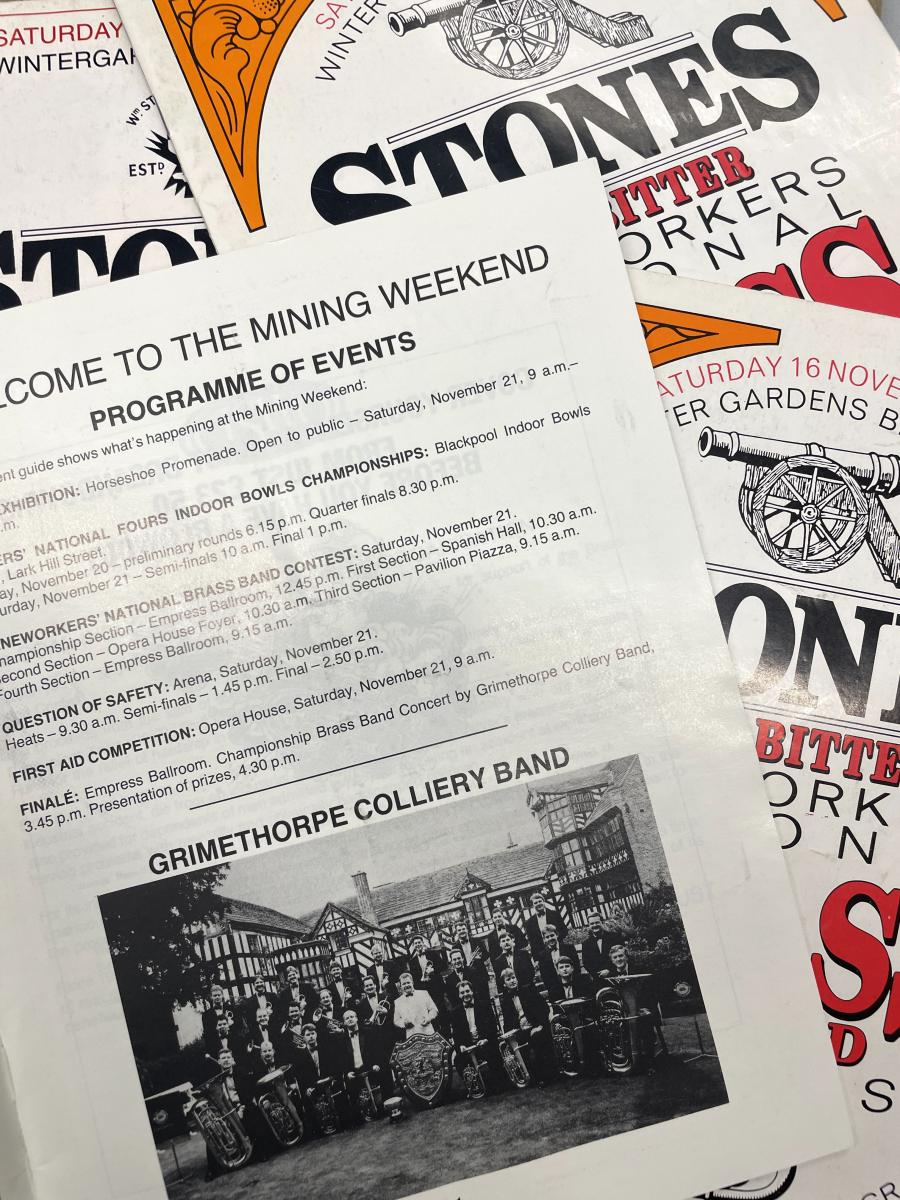
Mineworkers Contest Programmes [Ref: BBA/CM/P/5]
The early 1990s mine closures marked the start of a decline in the contest, leading to a reduction in participation numbers in the subsequent years. In 1994, 60 bands took part but that number dropped to 51 by 2000. This decline occurred despite relaxed rules and the suspension of a strict entry requirement that mandated at least 50% of band members be employed in the coal mining industry, be their dependent children, or be members of Miners Welfare Schemes. Many bands navigated these requirements by registering as members of their local
National Coal Board Club. However, this arrangement was not sustainable, and the decision to discontinue the contest seemed to herald the end of a significant brass band tradition. Thanks to the dedicated efforts of individuals like Stan Lippeatt and others, Butlins recognized the potential of reviving the Mineworkers Championships. This allowed the event to continue until 2022, although it was temporarily paused in 2021 due to the COVID-19 pandemic. The plans for a revival in 2024 have not come to fruition, and the brass band community is awaiting updates on the possibility of the event's return.
Miners’ Galas
The Annual
Miners’ Galas have evolved into significant political and musical events. One notable celebration is the Welsh Miners' Gala Day, which has featured prominent guest speakers such as Aneurin Bevan, Michael Foot, and Tony Benn. In 1975, the prizes for the brass bands at the Miners' Eisteddfod were presented by the Soviet Ambassador to Great Britain, highlighting its international significance. In the Northeast of England, where coal mining was a major industry, bands associated with collieries often served as key entertainment hubs for the local community throughout the year. A prominent event in County Durham is the
Durham Miners' Gala, commonly known as
"The Big Meeting". The inaugural Durham Miners' Gala took place in Wharton Park, Durham, in 1871, organized by the Durham Miners' Association, which had been established just two years earlier, in 1869.
Miners and their families traditionally referred to this event as "The Big Meeting" or the "Durham Big Meeting". However, the tradition predates the Gala itself, with roots in the early struggles for justice. Richard Fynes, in his "History of the Miners of Northumberland and Durham," recounts a massive meeting of miners held in 1831 at Black Fell, located between Washington and Eighton Banks. He describes how:
“the roads in the vicinity of the meeting presented an unusual bustle, with men walking in procession from the various collieries, bearing flags and banners, and accompanied by bands of music. The banners were numerous and colourful, each adorned with painted designs and mottos related to the ongoing struggle between miners and their employers."
The Archive holds the official March of the Durham Miners Association, which is dedicated to the miners of the British Isles. This is entitled ‘Big Meeting’ and composed by Reginald Wright. This piece is currently on display at the National Coal Mining Museum.
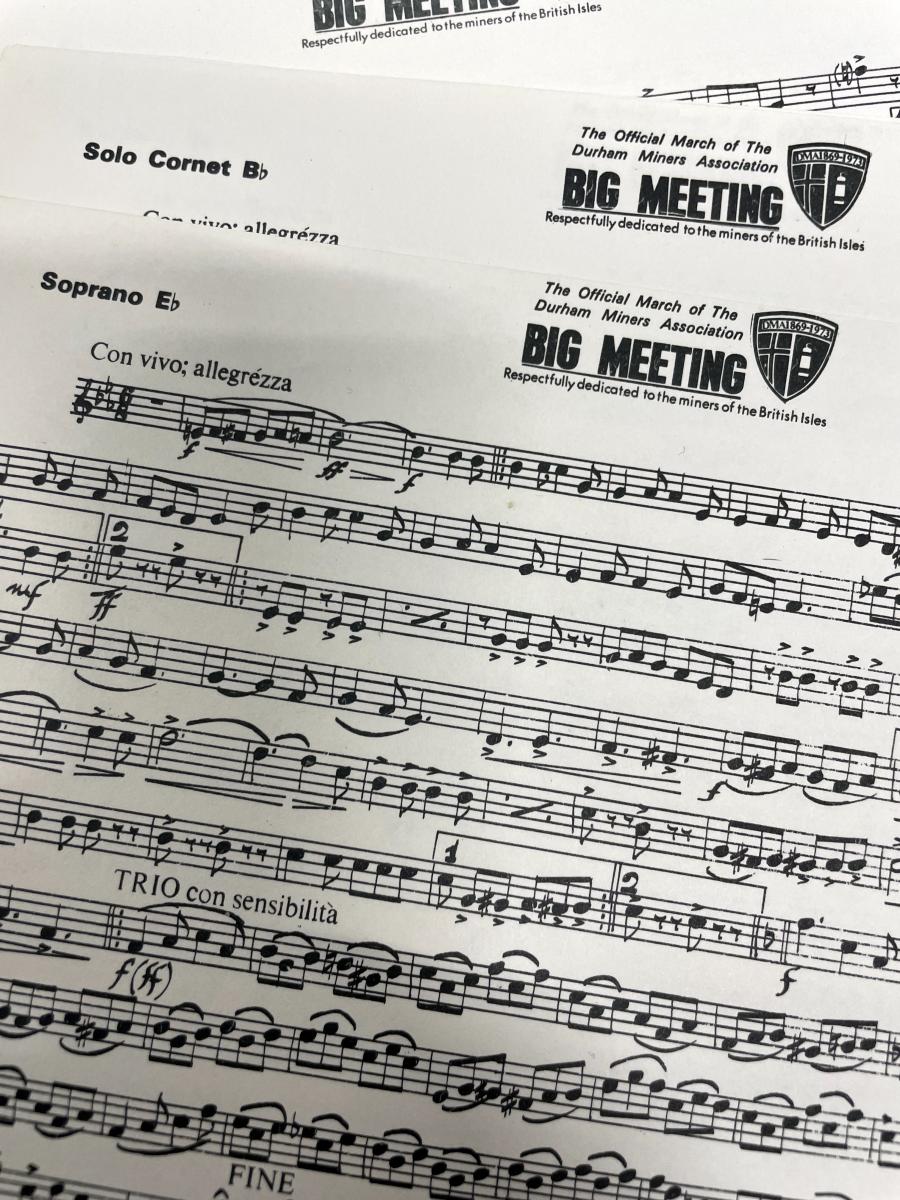
Big Meeting by Reginald Wright [Ref:BBA/SC/4283]
The Official March of The Durham Miners Association, dedicated to the miners of the British Isles.
After 1871, the Durham Miners’ Gala became a regular annual event, with interruptions only for the World Wars and major strikes. This celebration honours a unique culture that arose from the challenges of underground labour, highlighted by a parade featuring brass bands and vibrant banners. The hymn tune Gresford, composed by Robert Saint in 1934 to commemorate that year’s Gresford pit disaster, is performed throughout the day. While many colliery bands have vanished, events like this, combined with our brass bands' dedication and a strong appreciation for heritage, help keep the music alive.
.png)
Gresford by Robert Saint [Ref: BBA/SC/1667]